

We do things differently here, goes a device of the city I live in, the city of Literature, but if I were to say its name, you would definitely have different associations. That motto makes me think of an opening sentence of L.P. Hartley’s novel The Go-Between: ‘The past is a foreign country. They do things differently there.’ And so, as a writer who didn’t learn to read and write here, I am well aware that it is my presence that is foreign, which, of course, is of no importance to the multilingual metropolis around me. Being asked about it numerous times, I am compelled to say that I currently live in a country of Pistyll Rhaeadr, Durdle Door and Stock Ghyll Force waterfall, amongst which I would photograph myself and post with some good quote if I were an influencer. Since I am far from aspiring to such a cushy position, nor would I ever wanted to be consider blogger, v-loger, sloger, or whatever the next -ger turns out to be. I’ll stay where I am, writing in the dark behind a wall of spruces, or rather by no paywall by the river with no chance for a final dive.
So, after this quick and straightforward introduction, time to talk about the weather, shall we? Yes, we reached freezing temperatures, which, I hope, have not wreaked havoc in your life. Nature, unlike the algorithms, at least has the decency to be openly indifferent to our preferences, but rather makes many of us resonate with Fillyjonk, who, strictly saying—in November—”knew that autumn had come, and she shut herself inside. Her house seemed entirely forbidding and deserted. But she was in there, hidden in its innermost depths, with its tightly sealed walls and a wall of spruces covering the windows.” Learning that your home is well insulated is a great relief and I would like to be delighted to hear that you created yourself a cosy reading corner where you devour all the novels you purchased in the nearest metropolis.
Therefore, am I writing an essay? Perhaps, possibly the last one, not because I am planning any radical jump, but because that’s entirely not my story, which seems to belong to the greatest.
Salman Rushdie, in his essay written in 1982, in Imaginary Homelands, from London about the Bombay he had left, accepted that he could never reclaim the real city. What he could do was build a version of it, “imaginative truth”, a thing that is “honourable and suspect” at once. To my mind, the novel offers the greatest space for all of this, and Rushdie, in any case, has excelled in it. Speaking of novels, let’s get back to Harley, whose novel was adapted for the screen, a historical drama.
The relics were not exactly dirty nor were they quite clean, they had the patina of age; and as I handled them, for the first time for over fifty years, a recollection of what each had meant to me came back, faint as the magnets’ power to draw, but as perceptible. Something came and went between us: the intimate pleasure of recognition, the almost mystical thrill of early ownership — feelings of which, at sixty-odd, I felt ashamed.
— L.P. Hartley’s novel The Go-Between
Leo handles his relics, and he gets “recognition” and “ownership” from doing so. In a museum, you are most of the time, if not always, forbidden to touch. For a writer, description can stand in for the touch we can’t have. We cannot hand readers the frost on the windowpane or the rough bark of a spruce, so we arrange words of fiction that serve as a doorway. What we usually want is to touch, to tap on the surface of things and begin a conversation about something deeper that the reader can reach whilst retreating indoors. And when that exchange gives us and our readers a thrill, the small shock of recognition across pages, years and sometimes languages, we have captured the whole point of doing it wherever we are sat on this planet, where there is no such thing as perfect happiness, absolute certainty or pure perfection. Despite our flaws and foibles, doggedly but compassionately, we could not keep going without the companionship of words.
Rilke, who believed that “Love consists of this: two solitudes that meet, protect and greet each other” tells us not to fear seeming “too sensitive”, and from today’s perspective, when we teach our children to apologise for what they have done rather than for hurting someone’s feelings (suggesting someone might be taking it a bit too sensitively), Hartley’s narrator feels the very fear Rilke warns against.
A child’s “mystical thrill of early ownership” is the opposite of a museum, where everything is held in common and no one owns anything. That is also what a museum label or an archive finding aid does, and it is a technique for moving from object to story. Hartley puts a sixty-year-old at the centre. He is revisiting a time that was perhaps not innocent, and he is not a fully reliable guide to it. It is the same position as a writer returning to notes, drawings or trips. By linking experiences, building a narrator’s voice whose memory is fallible and whose vision is fragmentary, where the doubt is part of the structure, a craft tool, the writer tells the reader whose eyes they are borrowing. The broken pieces of memory gain weight precisely because they were remains, and the gaps are where the reader’s imagination comes in. A narrator who corrects himself, or contradicts an earlier detail, is more trustworthy than one who is never wrong.
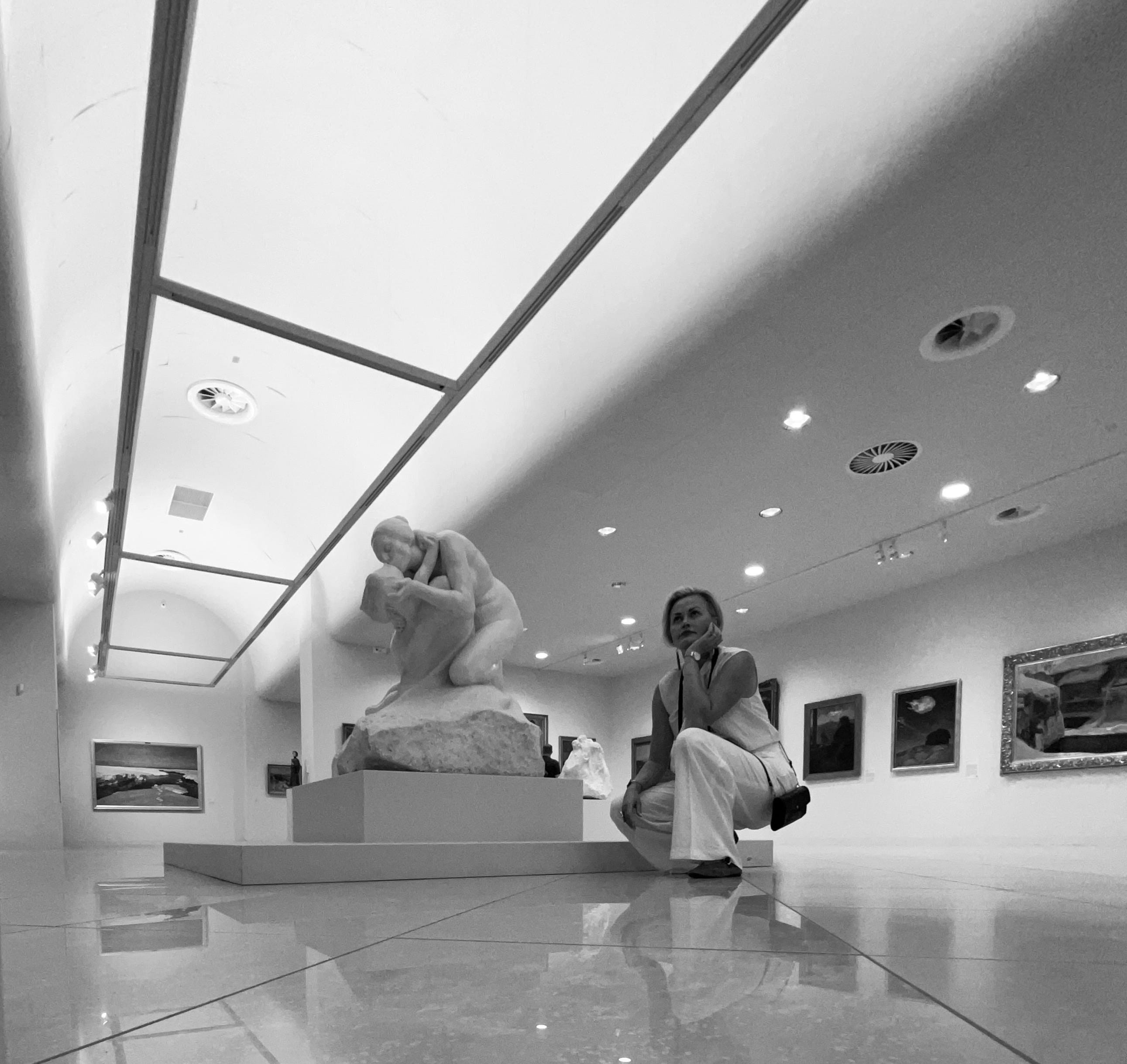
Rushdie, in his essay, inverts things: the photograph told him that the past was home and that the present was the foreign place. That inversion is a gift to the writer; the insider is an outsider at once. A gallery visit is a good model: you belong there, and you don’t. And the present is also a version, just as your depiction of this very moment in a few days, if not tomorrow, is as partial as your memory of the summer two years ago. Unless you revisit the events by watching videos and pictures from that time, you probably cannot recall more than a few fragments.
Create fictions, not actual cities or villages, but invisible ones
— Salman Rushdie
The words “invisible ones” work forward as well as back. A future is also something we make fictions about, made of specific shards, where its influence comes from concrete detail, which, as Vaihinger’s in The Philosophy of “As If” puts “in spite of its theoretical nullity may have great practical importance.”
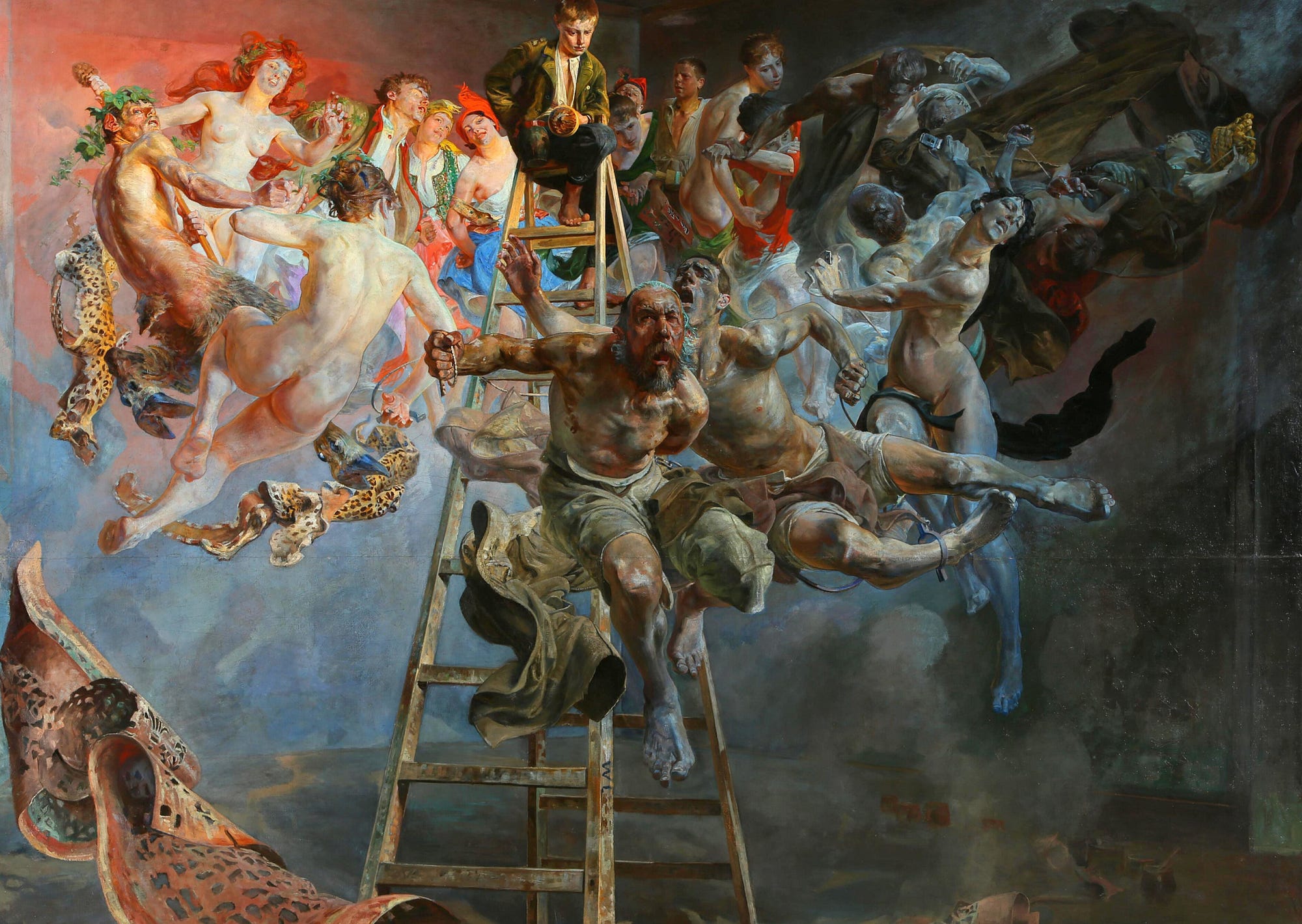
In the painting Vicious Cycle, just over forty years old artist represented himself as a pensive boy sitting on top of a stepladder above the titular vicious circle and holding a brush in his hand. He is surrounded by the naked bodies of Bacchantes; youths and elderly men personifying the feelings and imagination of a young artist. Paradoxically, they seem both real thanks to the painting’s illusory visual expression and unreal because of the abstract space they occupy in the painting. The left and better-lit side of the painting symbolises sensual ecstasy, while the right, dark side represents the fears and anxiety of the artist. The work can be interpreted as a question on the nature of art and the vocation of an artist.
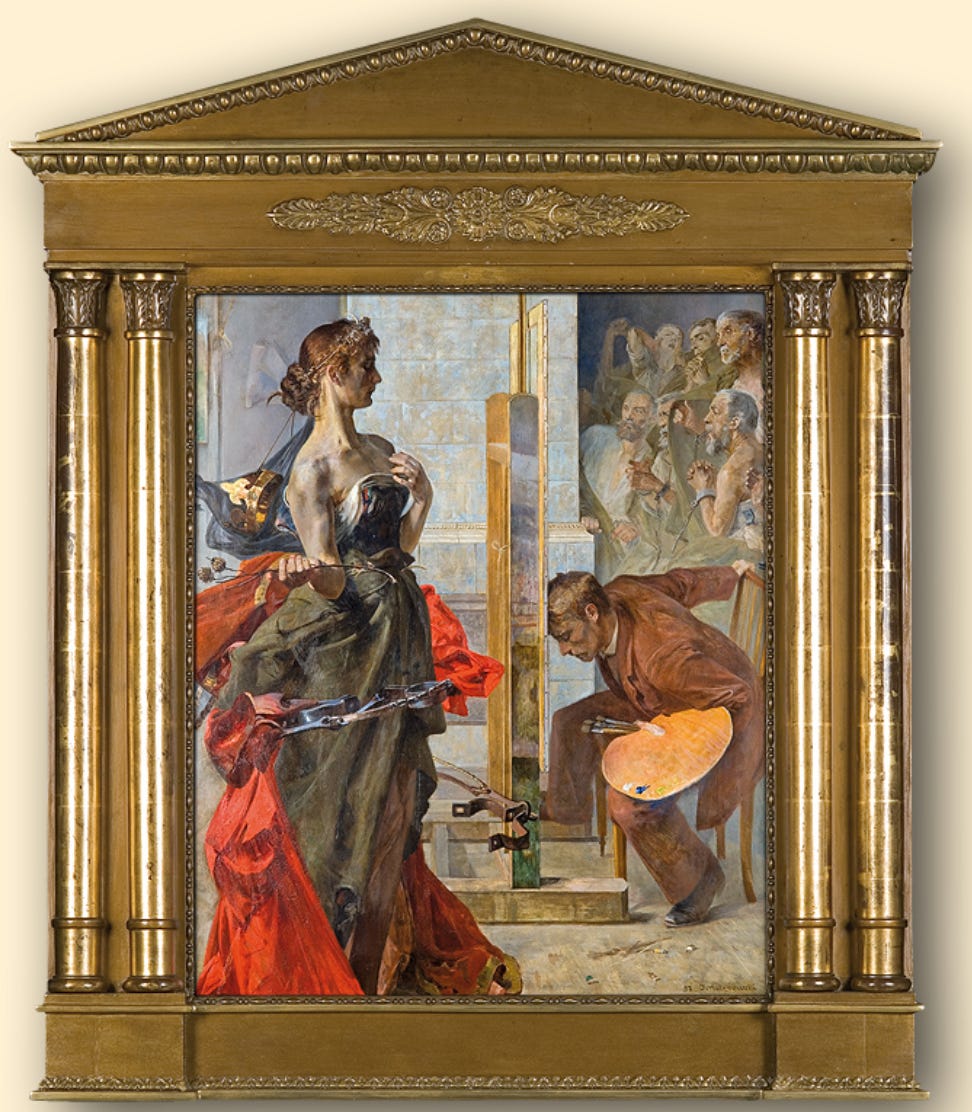
Another painting by this Symbolist, Jacek Malczewski, son of Maria, the daughter of a former officer in Napoleon’s army, and of Julian, a widely read patriot who introduced him to Romantic literature… In an auction catalogue, its title ‘Vision’, on the label of a Warsaw antiquarian, it was once ‘The Painter’s Vision’, elsewhere it appears simply as Polonia. The latter explains itself: Poland had been wiped off the map in 1795, divided between three empires. Malczewski was born in 1854, in a city under the Russian crown.
His art, the National Museum in Poznań, where I once more admired his works this summer, tells us much about the muses, angels, ghosts, allegories. ‘Vision’, completed as we know it, is inscribed on the back of his great canvas ‘Melancholia’, painted between 1890 and 1894: Melancholia. Prologue. A hundred years had passed since the final partition. On the canvas, a tangled crowd of allegorical figures — priests, insurgents, women, children — pours out of the painter’s easel towards a bright window, and only the weakest of them ever reach the sill. Three years later, he took that one word and gave it to the panel, as if to say: the vision is no longer the prologue. It is the whole painting where the same female figure appears: at once the Muse and the allegory of a country, what an artist longs for and what he is forbidden to touch. In the sister painting, The Painter’s Inspiration, the museum in Kraków describes her as dethroned, enslaved, wandering: a straw crown slipping down her back, shackles at her feet, a Russian greatcoat wrapped around her hips, and in its folds, a soap bubble.
A soap bubble…
Malczewski would keep painting her for more than two decades. The great Polonia cycle was closed only in 1918, when Poland returned to the map.
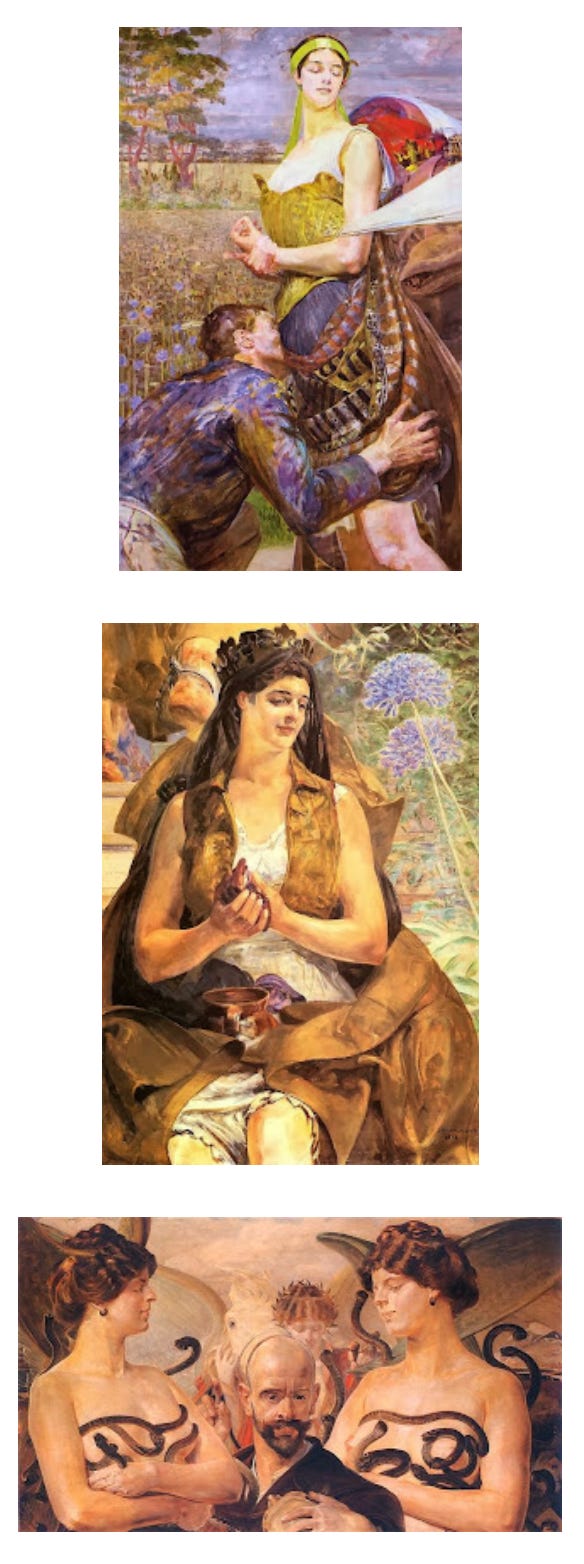
And there is one more detail: Malczewski, who spent a lifetime painting visions, lost his sight towards the end of his life. He died in Kraków eleven years after the country he had dreamed in the shape of a woman came back.
Perhaps that is all a writer can hope for. We describe what we cannot hold and we trust it may open for someone, somewhere, long after we’ve stopped looking. I want to carry on with my writing, but one thing is sure: I am not a blogger, and as one behind the wall of spruces, where frost holds, I hope you are warm, since “a book must be the axe for the frozen sea within us.” I would never presume so much of my sentences. But if one day any of them will crack the ice, then the lamp behind the spruces was worth keeping on.
SOURCES
Tove Jansson’s Moominvalley in November, 1960.
Salman Rushdie, “Imaginary Homelands”, London Review of Books, vol. 4, no. 18 (7 October 1982); reprinted in Imaginary Homelands: Essays and Criticism 1981–1991.
Utpictura18 database (Aix-Marseille Université), notice 015452
Agra-Art auction catalogue, 7 December 2008, lot 12170, and catalogue note for Malarczyk i Muza (2014) Muzeum Narodowe w Krakowie, entry for Natchnienie malarza, Muzeum Narodowe w Poznaniu, descriptions of Malczewski’s works
Ponad słowami (Nowa Era) and Polish art-history sources on Melancholia’s full title.
Wikipedia, Jacek Malczewski and Vicious Circle.