
I don’t know how many years have passed. I don’t know how many times I’ve persuaded myself not to remember us. Yes, that wet-behind-the-ears version of us. You, in your black sweater and glasses alike, and me, drinking my first Viennese coffee on our trip together; how we visited a shop with candles and how I gifted you a photo frame with giraffes, since “giraffe” was my nickname. It must have been May, although I cannot possibly remember that.
Funny enough, the memory of these moments comes to me when I see so many expiration dates approaching: the ointment that will always be fresh and working despite the date on the package; the coffee I’ve been keeping for special moments—and now those moments are forced to arrive before the end of this month. Although I will stretch those beans—oh, how I will stretch them…
Many people, armed with the knowledge they already have about me, think that I have not arrived at small joys, but at a handful of minor matters; that I have not encountered clear traces of longing for what is eternal and magnificent, only undeniable evidence that most humans are guided by a petty instinct for momentary satisfaction. Today, nothing stops me from acknowledging this; more than that, I find in it a peculiar delight—to call, using worn-out terms, the struggle I wage in this situation, in a human world oriented solely toward tangible realities, a struggle to discover subtle form, “desperate.”
I had in mind a form that could express a situation stripped of perspective, the times in which people… as simply put as possible… live deprived of ideals. And a manner or form, even the subtlest, to express such a thought, I understood relatively quickly, cannot arise from our will, just as thought does not know freedom without limits. This manner of expression or form, I believed, must stem from a sensitivity. And this was precisely what I could not find in generality: I did not find the sensitivity, and the fact that I could not find it—because it was not there, among the majority—filled me with the aftertaste of which I cannot rid myself of to this day. I drink the sour, and I drink the sweet, the spicy and the salty; I try everything, yet... My experience tells me that a story like mine does not capture the attention of the majority of today’s listeners. And this certainly does not happen because, though utterly banal, it is, according to them, too “difficult”; rather, it is because everything that reaches them from this direction bores them, namely because they do not understand how someone cannot acknowledge that the human world is either vulgar, or deceitful, or both vulgar and deceitful at once.
C’est pourquoi tu me manques. Yes, you are missing from me. As present as you are and as absent you recall “things” to me. You are reminding me of you. Tu me manques plus que je ne le pensais. I was clearing my desk yesterday, and my mind brought up the words from Shin Kyung-sook’s The Court Dancer: Whoever carries music within will know solitude, even when the listening is shared. For music speaks not through the nearness of bodies, but through the intimacy of the soul. But then all this soul nonsense we are meant not to believe, for its very reason, only God is your soul-mate, all other relationships are lived, only if we want them to live. And so I thought of another words from him:
Tidying my desk always makes me think of preparing for death. Once, after cleaning the room this way, I looked back with such terror that I returned and scattered my things all over again.
And yes, my desk was tidier, the right drawer fuller of all the things that live there and my memory of you was livelier than ever.
So I thought of all the outings we had—how I tried capers and anchovies with you for the first time, how I took pictures along the way. I thought of a discussion we had on Hamlet, on IT, on adultery, and on poetry, all at once.
And when I recently went shopping, I strayed to the bookshelves, as I always do, and read one of the poems from For the Women by Donna Ashworth. And that is poetry exactly—the kind we do not like is precisely the kind we do not agree with. And that suits me.
Yes, this is the first half, because I did not agree from the very first line. Yes, my thinking of Donna will not change because I don’t like this and some other poems of hers, I still believe she shares the same father with another friend of mine, although there is no proof found, at least for now, as no one is digging… Can you imagine how many women, still conforming, are reading this?! I must think they are still very young. How else would one not figure it out? We don’t see things as they are, we see them as we are, as Anaïs Nin would perhaps put it. In this regard, I am a very old soul; I always was.
I open The Diary of a Young Girl (Anne Frank’s) and read:
Everyone here is reading a book called Salute to Freedom.
Mother thought it was extremely good because it describes a number of adolescent problems. I thought to myself, a bit ironically, ‘Why don’t you take more interest in your own adolescents first!’
(…)
It’s funny, but I can sometimes see myself as others see me. I take a leisurely look at the person called ‘Anne Frank’ and browse through the pages of her life as though she were a stranger.
Before I came here, when I didn’t think about things as much as I do now, I occasionally had the feeling that I didn’t belong (…) and that I would always be an outsider. I sometimes went around for six months at a time pretending I was an orphan. Then I’d chastise myself for playing the victim, when really, I’d always been so fortunate…
(…)
Everything has become much worse here. But you already knew that. Now God has sent someone to help me: Peter. I fondle my pendant, press it to my lips and think, What do I care! Peter is mine and nobody knows it! With this in mind, I can rise above every nasty remark. Which of the people here would suspect that so much is going on in the mind of a teenage girl?
And I laugh to myself, as a teenage girl, and I think that my soul is so so young, just like yesterday when I found a card from my dear girlfriend, she wrote to me in 2005 after our outing to the same city we went to that day when the sun was so beautifully out. And before, on the way to the train station, when crossing the veg market in summer, she told me that she had got engaged to a man who was going to change her name to what literally translates to puncture. And this brings me to what Tomas Tranströmer noticed,
“Two truths approach each other. One comes from within, one from without — and where they meet we have a chance to catch a glimpse of ourselves.”
And yes, I still do not understand the popular phrases, for example, reading for pleasure… The last six books I read tore me apart, disturbed my sleep, to say the least! One of them? Set in a bleak town, a travelling circus featuring a colossal stuffed whale and a mysterious figure called the Prince arrives. Their presence disrupts the fragile social order, unleashing hysteria and violence. That’s in two sentences The Melancholy of Resistance, but what I liked in those novels, alongside others I discovered, is how dense and continuous they are, often running pages without paragraph breaks. That feeling of entering someone’s current thoughts is also present in Krasznahorkai’s novel I am reading right now (Nobel Prize for literature 2025), a gift. So, here, below, I am sharing a slightly altered version of the poem by LANGSTON HUGHES (Why would I not shorten it to my needs?)
I, too, sing.
They send me to eat in the kitchen
But I laugh,
And eat well,
And grow strong.
Tomorrow,
I’ll be at the table
Nobody’ll dare
Say to me,
“Eat in the kitchen,”
Then.
Besides,
They’ll see how beautiful I am
And be ashamed.

Would you believe we have just entered a Year of the Fire Horse (symbolising passion, dynamism, and transformation)? So hear, please hear this poem entitled in the original Jianzi Mulan Hua by Su Shi, who wrote it from a remote corner of the world (sent there as a political punishment):
Beginning of Spring
Spring ox, spring staff
From the ocean’s edge, the boundless spring breeze sweeps ashore.
Hand in hand with Nature’s hidden artisan, It blushes peach blossoms to a tender, living rose.
Spring streamers, spring talismans
A sudden vernal gust sobers the lingering wine.
Not like the far-off ends of earth
It whirls up willow down, drifting like a snowfall of silk.


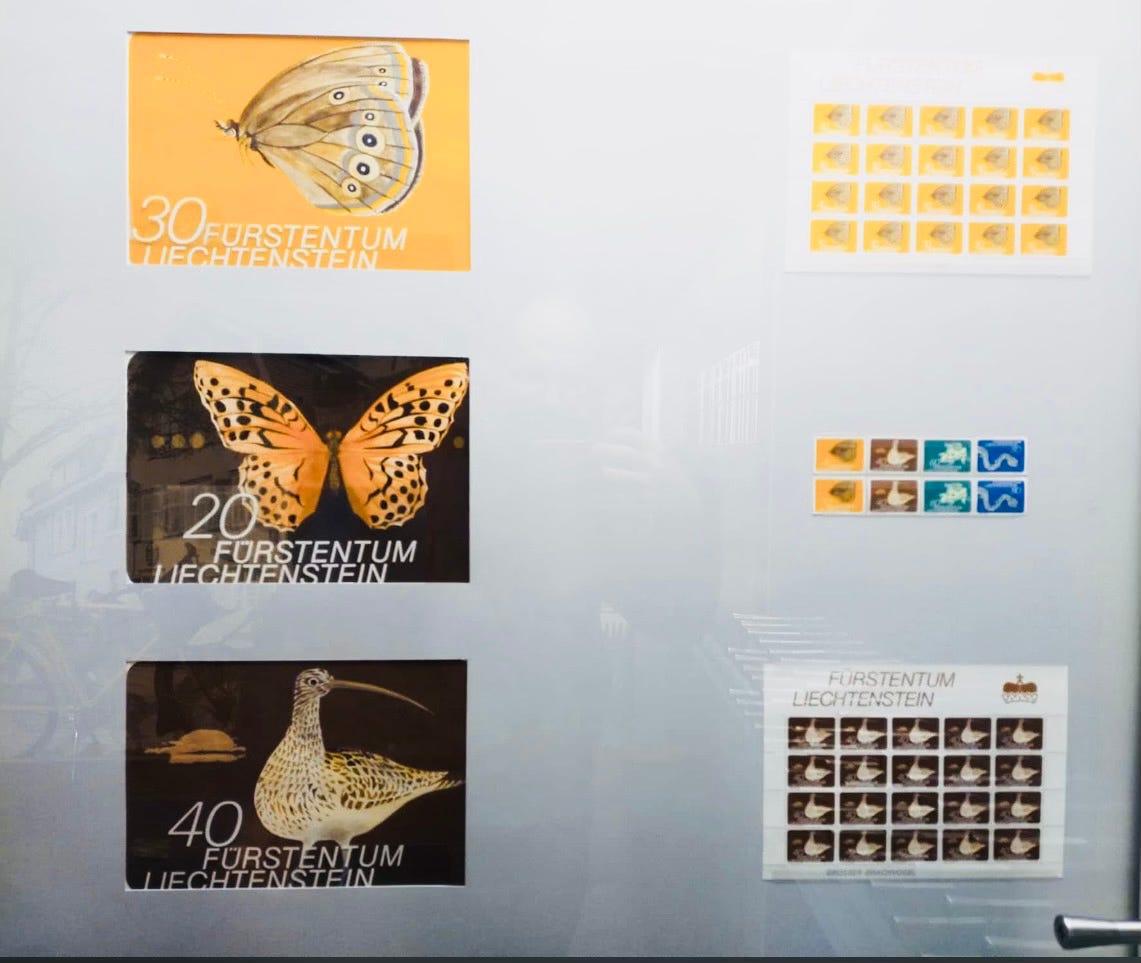
I lost it at the Liechtenstein stamps going all the way back to 1912, because that is such a specific kind of love-archive.
You are a friend at the table across the sea, brought close by timeless words. The fresh taste of truth has no expiration. No meter can cancel the value of its stamp. Keep arranging the letters. They are read...and enjoyed.