

I will begin with something that isn’t standard. So maybe you’ll feel a bit uncomfortable, because it’s not the kind of question that’s usually asked. If you want, you can answer; otherwise, we’ll change the question, okay?
Yes, let’s try.
Okay, so when you woke up this morning, a Congolese national, but resident in Burundi, what did you think about? What was the first thing you did?
This morning, when I woke up, I was thinking about what I was going to do and where I was going. I’m going on holiday, but it won’t be completely a holiday because I’m going to another country. I thought about what I could create, what I could do there, how I could enjoy it — because it’s not easy to leave our country and go to another one. For us here in Africa, it’s really not easy; it’s something difficult.
So, I thought about trying to create something, to build a network. I thought about taking my works with me and trying to create something there, to make the most of it.
And where will you be travelling?
I’m going to Uganda. From Burundi.
You said you want to create something. Is that instinct to create — wherever you are, wherever you go — part of who you are? Or is it more about being useful, using the moment to gain experience, visibility, recognition?
Yes, that’s it exactly. Visibility, recognition, and creating a network. Starting with a continental network is much better for a career. For us, especially when we have the chance to travel like this, we take advantage of it. I am talking to the Ugandan artists — creating a network with them — it’s something many people never get the chance to do. To move, to go somewhere else. So it’s about networking, recognition, doing as many things as possible. Creating an exhibition with them, growing the portfolio — that kind of thing. I’ll work with a man here who does acrobatics. I’ll talk to him, I think.
I want to create something here first, then let it grow.
The inspiration will come.
Maybe from myself, maybe from there.
Creating an exhibition will take time; it all depends on how the conversations go with the people I meet there.
But I’m ready and open to everything: artistic collaborations, galleries in Uganda, new contracts — everything.
You have more than four years of experience.
Since 2020, I really started drawing professionally. Before that, I enjoyed it since childhood. I even helped with organising drawing competitions and exams. Even when I was a student myself, I’d take part in an exam I helped to create. So from a very young age, drawing was already there. But professionally, it started in 2020, and I was never an art student.
Now let’s talk about your artworks. Let’s start with this piece, Idéalisme. Where does the idea come from?
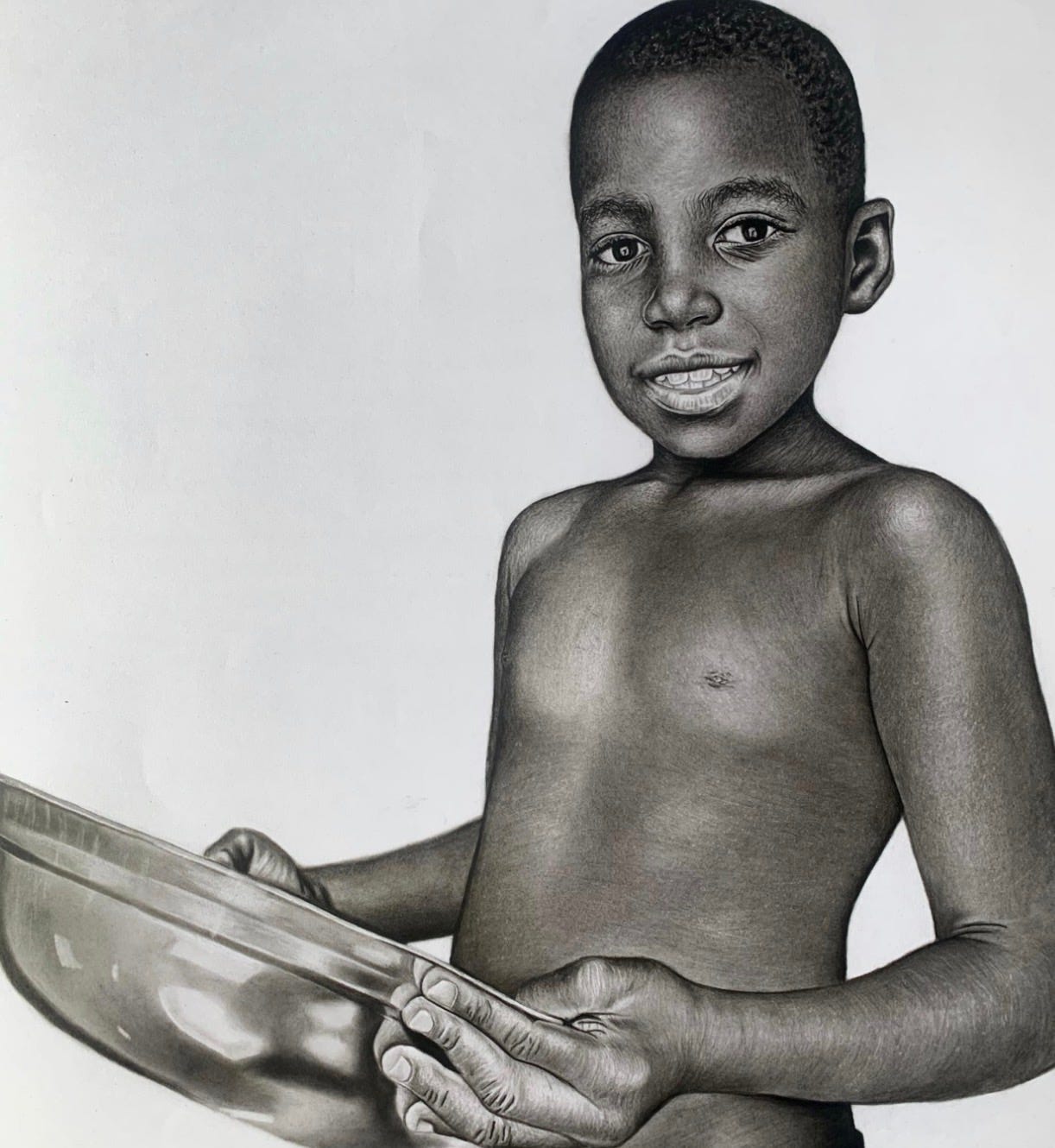
This work talks about identity. African identity, especially. Our children here don’t live in the same world as children in Europe.
You see the empty plate — that’s important. That’s why I called it Idéalisme. He’s developing ideas on his own, without guidance. He doesn’t know who he’ll become, how he’ll start, which path he’ll take to become who he wants to be — or who he believes he is. But he keeps going.
There’s hope. There’s a smile — a confident smile. He tells himself that one day he will become something, one day he will have something. That’s why I represented it with the empty plate. He has nothing — not even a T-shirt like mine — but he still has hope. That’s the idea behind it.
So the plate symbolises lack, and he’s full of hope and aspiration?
Yes.
What emotion do you want to evoke in the viewer?
It’s like a call for support.
When we see these children — many of them living on the streets — they are children who lack material things, but they are incredibly intelligent. Truly intelligent. Often, more than children who grow up wealthy.
They have hunger, desire, and ambition. So when we see these stories, it pushes us to support them, to help children who believe they can become something. That’s it.
Are you speaking a little about yourself in this work?
No. I’m speaking about what I’ve seen — what I see now. Burundi is one of the countries with many street children. We see this everywhere: on the way to university, in the streets. As artists, we have to try to do something.
I think it becomes another job for artists. As they grow and practice their art, they see that many others could do it too, but there’s a lack — a gap, as we say in English. Talent alone isn’t enough; some conditions need to change, and we can help change.
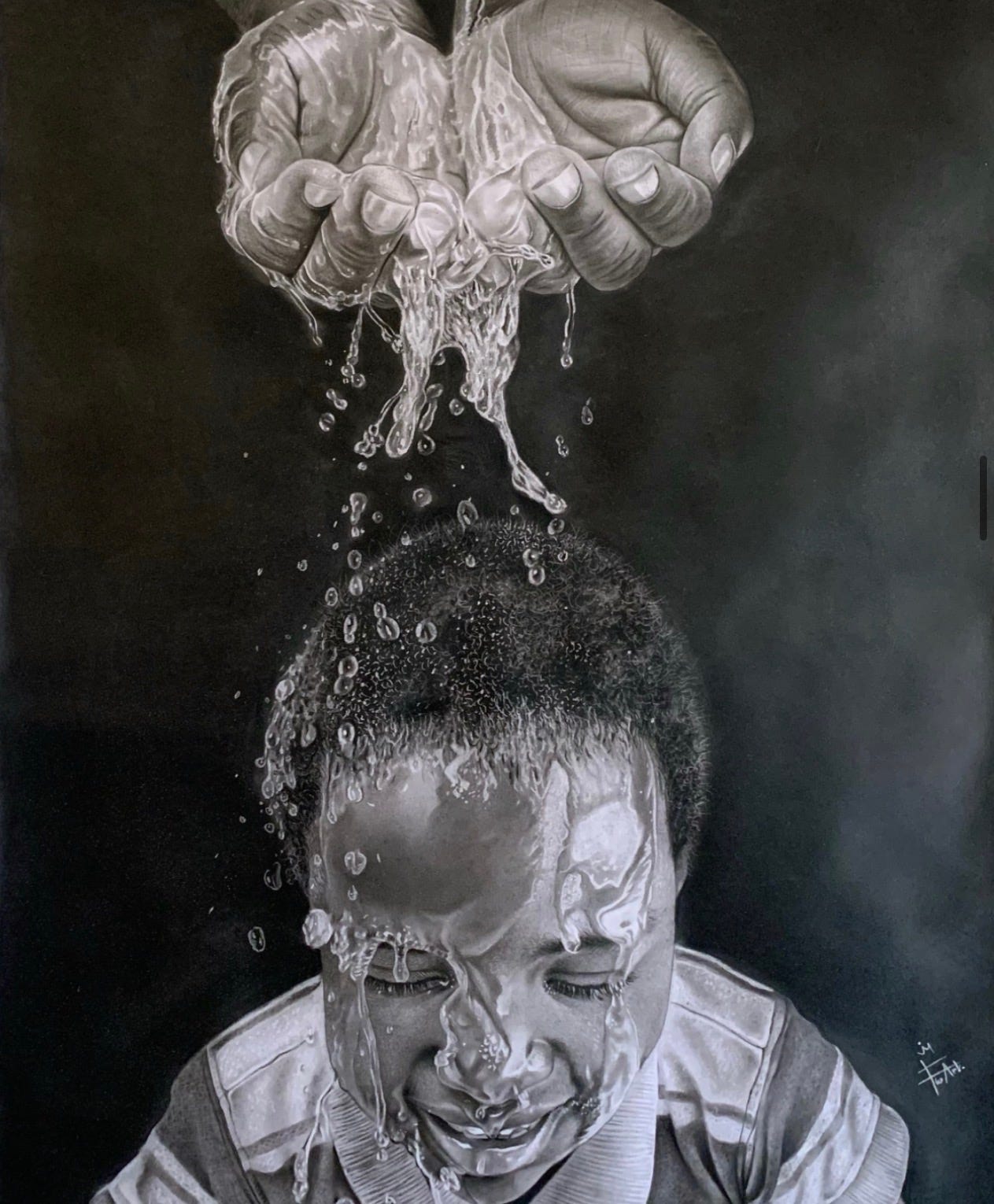
Let’s talk about Naître digne — Born with Dignity.
That was the first work I created when I arrived in Burundi. It’s a tribute to childhood and growth.
You see the hand pouring water — the source of life. It speaks about rights: the right to education, the right to life.
The water represents education and all the good things. The large hand pouring it symbolises the responsibility of adults, of society.
A child can’t give themselves an education;
it’s their first time living.
They must be guided.
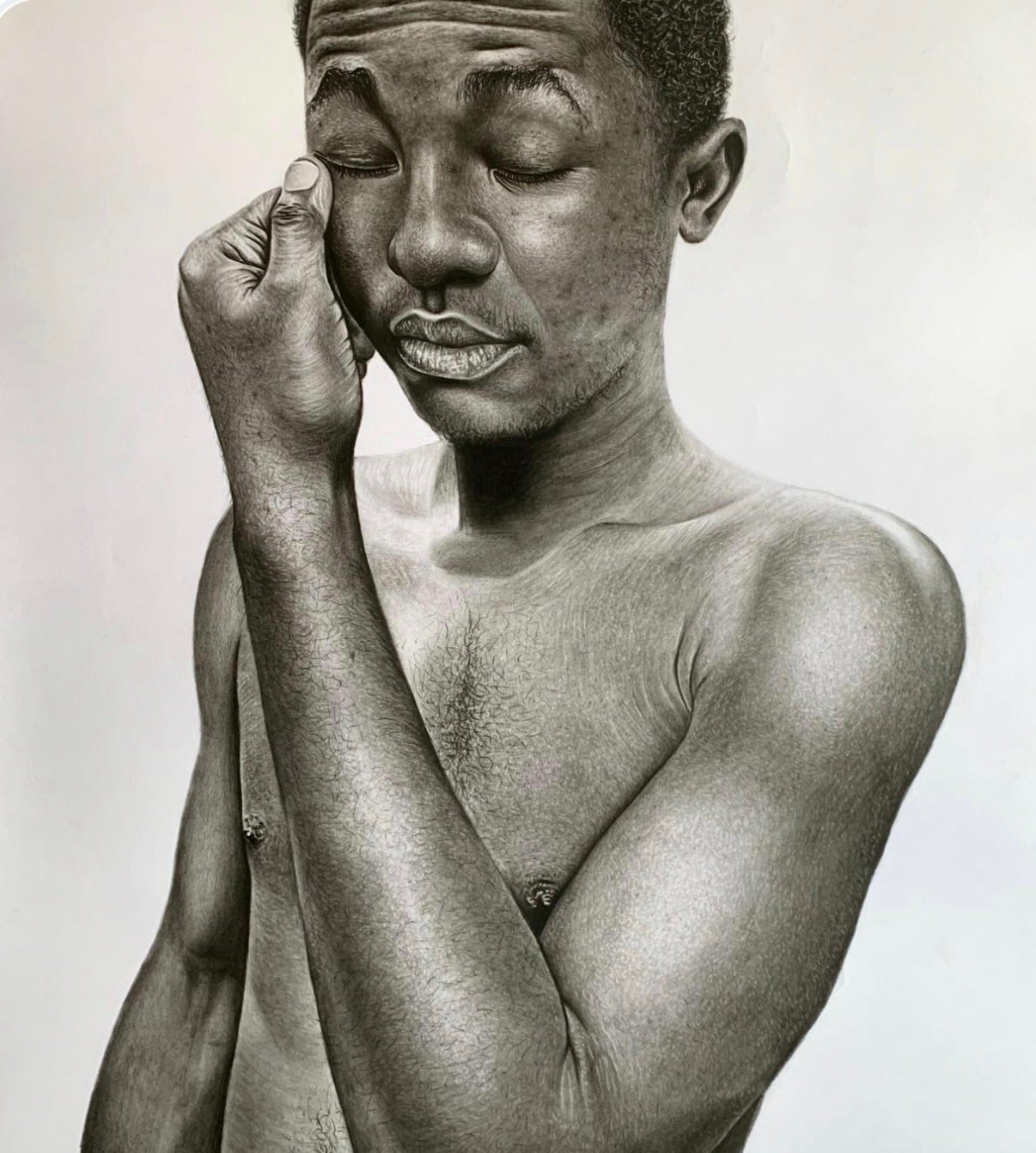
And Résignation?
“Résignation” is something else. That one is more about me. All the people you see in my works exist — they’re around me, friends, people I know. I created Résignation during a moment of chaos. I was preparing an exhibition, but I was down. I couldn’t work anymore. I had no resources to continue.
I still had hope. I prayed and worked at the same time. Résignation was a decision taken when the mouth can no longer speak, when you can’t express yourself anymore — but inside, you tell yourself you can continue, without panicking.
People saw the exhibition, but they didn’t know what had happened inside me — financially, emotionally, everything. After that resignation, I got up and continued working. And now, honestly, I feel like I’m entering another resignation. I’ve been down for some time; I haven’t worked for a month. But I believe I will work again soon.
Where does that inner calm come from?
It depends on the person. Everyone has their own way. For me, going somewhere I like, visiting someone I care about, going to a museum or cultural space.
When I see others succeeding, it gives me strength.
I tell myself: that’s my place too.
I need to stand up and work.
How is access to art in Burundi today?
It depends. Many people focus on portraits and commissions. I do them too, but I don’t think it’s a good long-term path for an artist.
An artist has a mission: to create a world, to transmit something, to build exhibitions. Portraits decorate homes, but they don’t always serve that mission.
Art requires patience. You might not be visible — the work is in front, not you. Many young people don’t like being invisible. And it’s not something that pays quickly.
I started in 2020. Maybe I’ll sell a work that supports me fully in 2035. Until then — how do I live?
That’s why I study telecommunications and IT. I combine it with art: graphic design, video editing. If art smiles, great. If not, I work. That’s how you survive as an artist here.
