
That people who have “measured” less in life will be impressed by what you do is no surprise — something, one might say, to be slightly avoided. But when those who have “measured a lot” call one of your skills impressive, the instinct is to nudge back gently: it’s not, especially if they possess that very skill themselves.
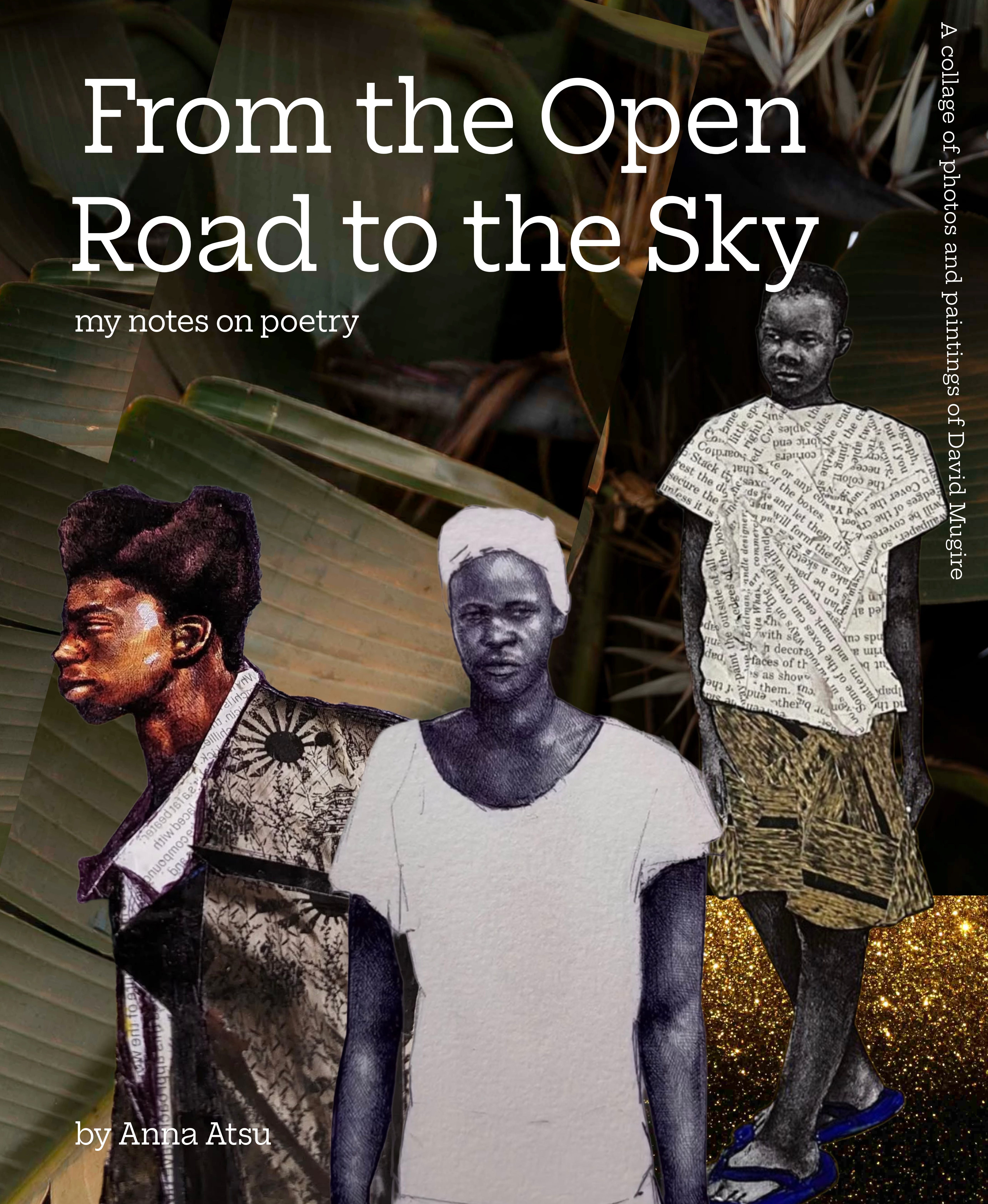
A collage using some of the artworks of David Mugire
I am not saying this only because I used the phrase quite recently and, the following day, watched a film in which a university professor and noted translator, Leda Caruso (The Lost Daughter), after disclosing that she comes from Leeds, hears That’s impressive and responds in the same way I did when approached about speaking French.
There is an old literary intuition — shared by Montaigne, by Simone Weil, by late Woolf — by which true measure produces restraint. Those who have lived inside a discipline long enough no longer marvel at its surface effects.
Montaigne writes not in praise of brilliance but of justesse — rightness.
The unimpressed are often not withholding admiration; they are refusing exaggeration.
Goethe, in his conversations, returns often to the idea that experience dulls astonishment but sharpens judgement. The master does not say anything extraordinary because they know how many ordinary steps were required to arrive there.
What looks impressive to the uninitiated looks inevitable to the initiated.
This intuition aligns closely with Nietzsche’s suspicion of applause. In Human, All Too Human, he suggests that praise often reveals more about the admirer’s hunger than about the thing admired. Applause can be a form of self-exoneration: I am moved because I cannot do this.
Those who “measured less” are not wrong to be impressed — but their admiration is no proof. It is emotional.
Literature has always warned us: admiration is cheap when it costs nothing to give.
Simone Weil treats attention — not admiration — as the highest form of respect. To be unimpressed may mean: I am looking properly. The person who possesses the skill and says, It is not impressive, is often saying: I see the seams. I know how much further this could go.
One should not trust the admiration of those for whom the thing admired remains miraculous. Miracles belong to distance. What is known from the inside ceases to astonish.
The unimpressed do not deny value. They deny illusion.
Let’s take a little fragment of literature, for instance, what Shakespeare is to England, or Goethe is to Germany, Walt Whitman is to the US.
In fact, on the first publication of his book Leaves of Grass, one critic declared, ‘An American bard at last!’ — although that review was a little biased, given that it was written by Whitman himself! Eventually, though, he would receive praise from others — and a lot of it. The Transcendentalist poet Emerson said of Whitman’s first collection that it was the most extraordinary piece of wit and wisdom that America has yet contributed, while years after his death, the modernist Ezra Pound said that he was ‘America’s poet.
He is talked about as being a democratic poet who spoke to and listened to the people and captured them and the national spirit in his beautiful verse, as seen in this poem.
Afoot and light-hearted, I take to the open road,
Healthy, free, the world before me,
The long brown path before me leading wherever I choose.
Henceforth I ask not good-fortune, I myself am good fortune,
Henceforth I whimper no more, postpone no more, need nothing,
Done with indoor complaints, libraries, querulous criticisms,
Strong and content, I travel the open road.
The earth, that is sufficient,
I do not want the constellations any nearer,
I know they are very well where they are,
I know they suffice for those who belong to them.
(Still here I carry my old delicious burdens,
I carry them, men and women,
I carry them with me wherever I go,
I swear it is impossible for me to get rid of them,
I am fill’d with them, and I will fill them in return.)
— Walt Whitman, Song of the Open Road
A sure sign of greatness is being pastiched, and so, further cementing Whitman’s status as an American icon, is this little comic tribute to his poem ‘Song of the Open Road’ by Ogden Nash. The descendant of the very serious General Francis Nash — the man after whom the city of Nashville, Tennessee is named — Ogden was known for not taking anything, least of all himself, too seriously. Instead he was famed for his sharp, whimsical sense of humour and his playful use of rhyme and language, often making up words as he went along. A Harvard dropout, he worked at the same advertising firm as the novelist F. Scott Fitzgerald, before going on to work at the New Yorker magazine. Like Spike Milligan, he was a master of quips, such as ‘In chaos sublunary / What remains constant but buffoonery?’
I think that I shall never see A billboard lovely as a tree.
Indeed, unless the billboards fall I’ll never see a tree at all.
One of the best-known contemporary American writers, Nikki Giovanni was the author of dozens of books of award-winning verse, essays, memoirs, anthologies and children’s poetry. Giovanni has devoted herself to teaching, and has been a professor. Of her work, she has said:
My dream was not to publish or to even be a writer: my dream was to discover something no one else had thought of. I guess that’s why I’m a poet. We put things together in ways no one else does.
Here is one of my favourite poems of hers (also performed by herself — a link to a long and amusing TED Talk by her—below).
I was born in the congo
I walked to the fertile crescent and built the sphinx
I designed a pyramid so tough that a star that only glows every one hundred years falls into the center giving divine perfect light
I am bad
I sat on the throne
drinking nectar with allah
I got hot and sent an ice age to europe to cool my thirst
My oldest daughter is nefertiti the tears from my birth pains created the nile
I am a beautiful woman
I gazed on the forest and burned out the sahara desert
with a packet of goat’s meat and a change of clothes
I crossed it in two hours
I am a gazelle so swift so swift you can’t catch me
For a birthday present when he was three
I gave my son hannibal an elephant He gave me rome for mother’s day
My strength flows ever on
My son noah built new/ark and I stood proudly at the helm as we sailed on a soft summer day I turned myself into myself and was jesus
men intone my loving name
All praises All praises
I am the one who would save
I sowed diamonds in my back yard
My bowels deliver uranium the filings from my fingernails are semi-precious jewels
On a trip north
I caught a cold and blew
My nose giving oil to the arab world I am so hip even my errors are correct
I sailed west to reach east and had to round off the earth as I went
The hair from my head thinned and gold was laid across three continents
I am so perfect so divine so ethereal so surreal I cannot be comprehended except by my permission
I mean…I… can fly like a bird in the sky…
Yes, we put things together in ways no one else does — but not because we are grander, or more astonishing. Just as the American poetry, at its best, is not impressed with itself (Whitman walks the open road; Giovanni ascends into the myth of the cheap miracle) our work holds because it has been measured from the inside, so to speak, from the open road to the sky.
As William Shakespeare would perhaps say:
“Things won are done; joy’s soul lies in the doing.”
Mm, “joy’s soul lies in the doing” just slid in and stayed. I did that little nod like yeah, fine, you got me. Gonna go do the thing… instead of circling it.
The distinction you draw between admiration and attention echoes Weil's notion that proper seeing requires withholding hasty praise. When Goethe suggests experience dulls astonishment but sharpens judgment, he's identifying exactly what happens inside disciplinary mastery—the surface effects that dazzle outsiders become transparent scaffolding to those who've built similar structures. Your framing of Whitman's open road against Giovanni's mythological ascent illustrates how American poetry navigates between democratic accessibility and cosmic ambition without collapsing into self-congratulation. The unimpressed expert isn't withholding admiration—they're refusing the illusion that skill appeared without countless ordinary steps. That refusal protects both the craft and the practitioner from the distortions of miraculous thinking.
Mm, “joy’s soul lies in the doing” just slid in and stayed. I did that little nod like yeah, fine, you got me. Gonna go do the thing… instead of circling it.
The distinction you draw between admiration and attention echoes Weil's notion that proper seeing requires withholding hasty praise. When Goethe suggests experience dulls astonishment but sharpens judgment, he's identifying exactly what happens inside disciplinary mastery—the surface effects that dazzle outsiders become transparent scaffolding to those who've built similar structures. Your framing of Whitman's open road against Giovanni's mythological ascent illustrates how American poetry navigates between democratic accessibility and cosmic ambition without collapsing into self-congratulation. The unimpressed expert isn't withholding admiration—they're refusing the illusion that skill appeared without countless ordinary steps. That refusal protects both the craft and the practitioner from the distortions of miraculous thinking.