Does Worry Belong to the Dead?
From Dürer to Bacon

I am recently working through some old notes, and today I paused at one. It is a question:
From an etymological point of view, does the word “martwić się” (to worry) have any connection with the word “martwy” (dead)?
I love questions; they open a whole landscape of understanding. Linguistically, at least in my home language, ‘worry’ and ‘dead’ share a root; philosophically, they share a condition.
I don’t mean worrying as fear of what’s next. That kind of worry focuses on survival mechanisms from back in the day when we lived in caves and could be eaten by a sabre-toothed tiger at any moment. That fear is less handy now, since our brains can’t tell the difference between a real and an imaginary threat, which means the ‘lizard brain’ activates at the slightest whiff of danger, even when it’s not actually dangerous at all.
Some would say ‘to worry’ is, in a sense, to live as if already half-absent — to rehearse one’s disappearance. To some extent, it is true, if all we do is practice small rehearsals of dying: paralysis of anxiety, the stillness of fear. Deeper, it touches on the most important philosophical question, whether life, with the full awareness of it, is worth living.
“The struggle itself toward the heights is enough to fill a man’s heart. One must imagine Sisyphus happy.”
— Albert Camus, The Myth of Sisyphus
Like Kafka’s characters, who are forever trapped in a machinery of waiting, the eternal worrier moves through life as if through a corridor of postponed endings. Each concern is a ghost — our consciousness, restless and luminous. To worry is to be alive enough to enter a dialogue of care with the possible death of things: of joy, of control, of the self as we know it. Worry then appears to us as one of the quietest forces that shape human existence — less dramatic than fear, yet more persistent in its existential weight, not always through literal depiction.

The winged figure halts in contemplation, surrounded by its tools yet unable to act. Artistic genius enters the realm of concern: the paralysis of potential. The “game” of decision and the agony of irresolution are intimate to this image. Here, worry is internal, cognitive, and embodied in the stillness. Through geometry, symbols, and a sombre tone, Dürer captures the mind that ventures into its own abyss.
Dürer’s intellect, introspection, and unrelenting perfectionism may have driven him to a state of melancholia. Dürer’s famed Melencolia engraving of 1514 has been called the artist’s psychological self-portrait, and indeed the image does convey the terrible struggle of high expectations and debilitating inertia, when excessive introspection paralyses the imagination.

Transitioning into modernity, worry blossoms into anxiety, crisis, existential vertigo. Munch’s The Scream is widely interpreted as the icon of modern anxiety. The figure’s silent gape under a blood-red sky shows a self shocked, overwhelmed, inundated with an inner roar.
Munch explained: ‘I was walking along the road with two friends — the sun was setting — suddenly the sky turned blood red — I paused, feeling exhausted, and leaned on the fence — there was blood and tongues of fire above the blue-black fjord and the city — my friends walked on, and I stood there trembling with anxiety — and I sensed an infinite scream passing through nature.’

In Van Gogh’s restless sky doesn’t scream — it spirals. The village sleeps while the cosmos twists overhead. The painting becomes a metaphor for the mind.
The artist wrote of his experience to his brother Theo: “This morning I saw the country from my window a long time before sunrise, with nothing but the morning star, which looked very big.”
Scientific studies even compare its luminance fluctuations to those of turbulent flows, the atmospheric hum beneath the visible; not focal but pervasive.

Bacon’s reworking of Velázquez’s Pope portrays worry in institutional guise: power twisted, a scream caged by paint. Worry here is the burden of being too visible, too known, too human when one is meant to be divine. The cage of representation becomes the cage of the soul, where worry is about presence, exposure, and the impossibility of hiding.
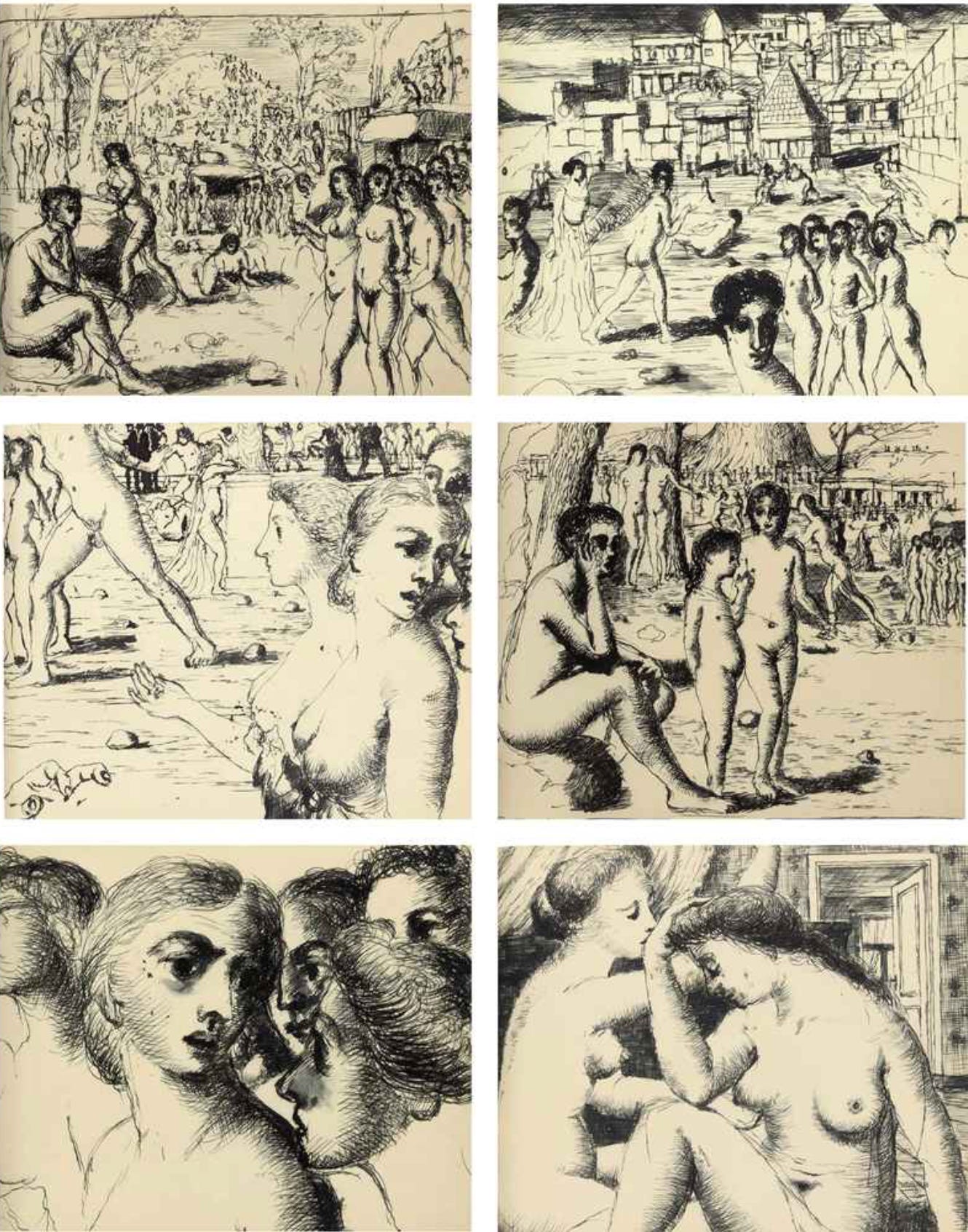
Across these works — and many others like The Anxious City by Paul Delvaux — we see a continuum: from intellectual paralysis, to modern anxiety, to existential vertigo, to institutional dread.
Worry might be both micro and macro: the one contemplating decisions, the many anxious in a city, the isolated figure in power.
Worry is more than just a psychological state — it’s an ontological stance. It asks: What if I am wrong? What if I am inadequate? What if this world fails me? Because humans create futures — goals, promises, plans — they must also live with the full awareness of the possibility of their collapse. That is what the visual arts help us see.
They don’t resolve worry; they stage it.
As Dürer might imply, we stop being motionless.
As Munch reveals, we hear the silent cry.
As Van Gogh conveys, we sleep while the sky itself turns.
As Bacon imparts, we remain exposed.


Where is the "LOVE" button!? Thank you for your insightful post.
Your post offers such a literally compassionate view into the subject of human worry, anxiety, and fear. Your words accompanying the famous artworks add a more precise dimension to what one feels while looking at the art. Much appreciated, thank you.