
Before The Music Stops
The more I read current great storytellers, the more I realise how much all those whose “hearts are tighten with an undefined longing for something infinite, something connected with eternity”* share literary role models such as William Shakespeare, Fyodor Dostoevsky, Marcdel Proust or A. A. Milne, how many of them still listen to classical music, such as the compositions of Johann Sebastian Bach and Ludwig van Beethoven, how many are inspired by old folk stories.
Today, as I read a story by one of those great storytellers, a painting came to mind, following the story on which it is based, which I remember reading vividly.
There is no great deal of talk about that short novella nor of its fictional character, represented in the painting, but the painter, who gave rise to what became Poland’s school of Symbolism, is well known, indeed, especially after he went to Paris, where he studied at the École des Beaux-Arts in the studio of Henri Lehmann, and subsequently moved to the Académie Suisse.
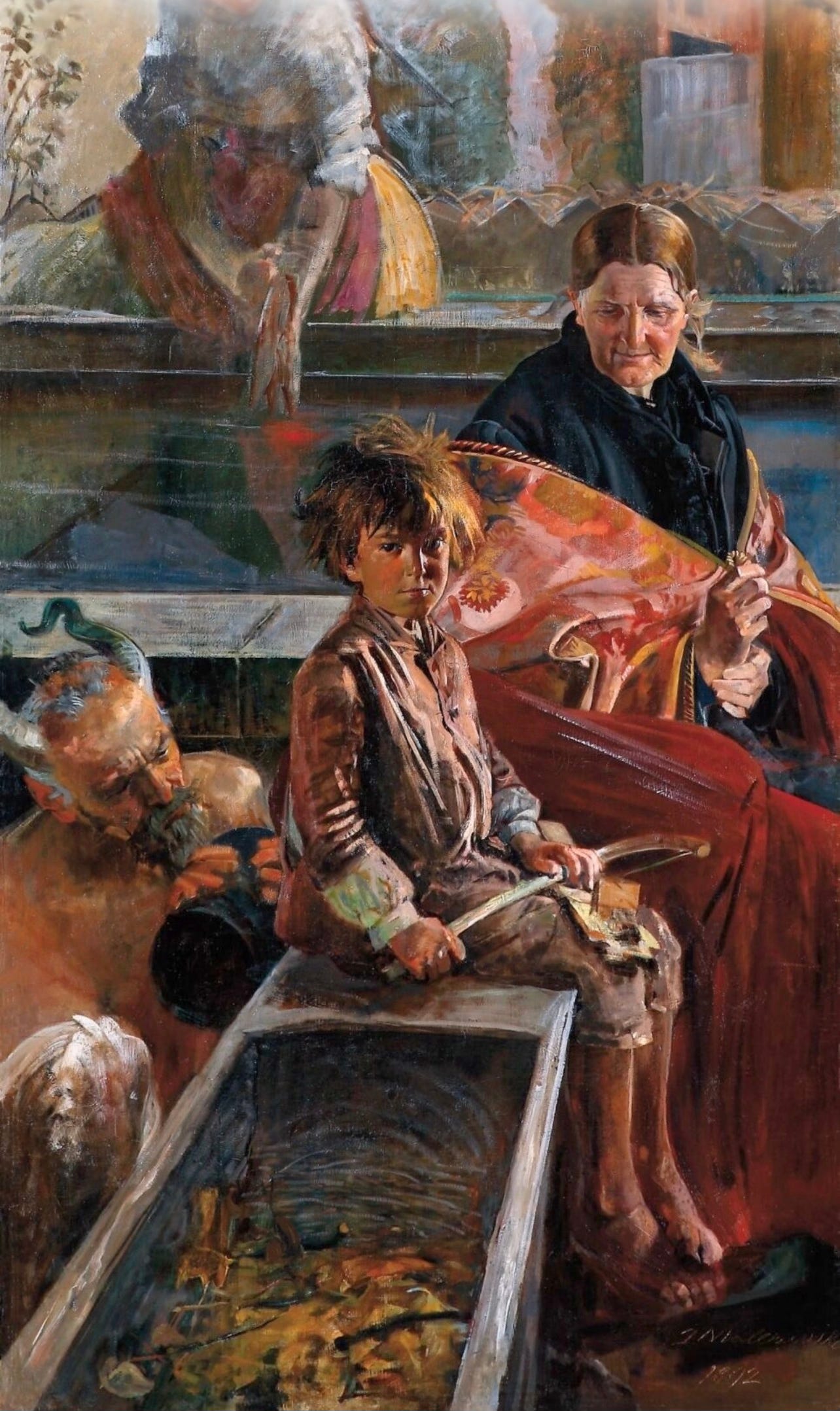
The painting…
“It came into the world frail, delicate…”
The painting depicts a very weak and sickly boy who does not come from the Boulevard du Palais; he comes from a poor cottage in a Polish village, as described by Henryk Sienkiewicz.
The women present at the birth believe that neither the mother nor the child will survive, so they baptise him before a priest can arrive. Contrary to expectations, however, the child survives and is given the name Jan, affectionately called Janko.
He is weak, often hungry, and poorly clothed. From an early age, he must help his mother by grazing cows, gathering mushrooms, and doing small tasks around the village. Yet the boy is different from the other children. He is extraordinarily sensitive to sounds and music. Whenever he hears music coming from the inn or from a wedding celebration, he stops and listens as if enchanted. The villagers begin calling him “the Musician.” No one truly understands his gift, however. His mother and other villagers consider him lazy, and he is often scolded or beaten.
Janko’s greatest dream is to have real violins. He tries to make his own instrument out of a piece of wood and horsehair, but it cannot produce the beautiful sounds he hears in the inn. He often stands outside houses or near the manor just to listen to music for a moment.
One night, the boy sneaks into the manor house where a pair of real violins belonging to a servant hang on the wall.
“The boy did not want to steal the violin; he only longed to touch it and feel its sound.”
Unfortunately, he is caught.
He is brought before a village authority and sentenced to a flogging.
“The great punishment was too heavy for his frail body.”
After the beating he is so badly injured that he cannot properly return home. Within a few days he begins to die. In his final moments he listens to the sounds of the village and dreams about music. Before dying, he asks his mother:
“Mother! Will God give me real violins in heaven?”
His mother assures him that He will. Shortly afterwards, Janko dies, and his mother weeps in despair.
At the end of the story, the narrator presents an ironic scene. The owners of the manor return from a journey to Italy, speaking with admiration about the art and musical talents they encountered there. They remain unaware that near their own home, Janko has just died.
“Janko’s talent was extinguished before the world could notice it.”
We live in a world where around 155,000 children per year die from abuse and neglect worldwide. Tens of thousands of those deaths are linked to violent discipline or severe corporal punishment.
The greatest moral failures often arise from a terrifying absence of thought.
Janko’s village does not intend to destroy a musician after all; yet his case calls into question the moral order of the world. If a civilisation allows children to perish unnoticed, what does that civilisation truly value? If children are allowed to disappear into poverty, neglect, or violence, the loss is not only personal—it is cultural, and when is humanity going to break the chain of hundreds of thousands of cases of fatal ignorance?

Never Violence is the title of a speech made by Astrid Lindgren in 1978, when she received the Peace Prize of the German Book Trade. It is one of the most well-known and influential speeches by Lindgren, where she speaks against corporal punishment of children. A year later, in Lindgren's home country Sweden, a law was passed that forbade corporal punishment of children. In 1978, the speech was first published as a book. In 2009, a German short film called Never Violence (original title: Niemals Gewalt) was published at Children's Day and was based on the story mentioned in Lindgren's speech.


Remarkable rendering of the painting's backstory. Fluid and brings the piece to life.
This reminds me of a similar condition in the American South. Children who heard music in their towns were hungry for the opportunity to learn and play music, but even the mail order Sears guitars were beyond their families’ reach. What they did was nail a discarded string to the wall and “fret” it with a finger or a slide to create lines of notes. It was called a Diddly Bow, and that was the first “instrument” for Buddy Guy, Elmore James, and a thousand other masters. It’s not known if Bo Diddly ever played one.