


I tried to gather some information about you.
Where from?
From something called the internet.
OK, stalking me.
Hehe. Before talking to you personally.
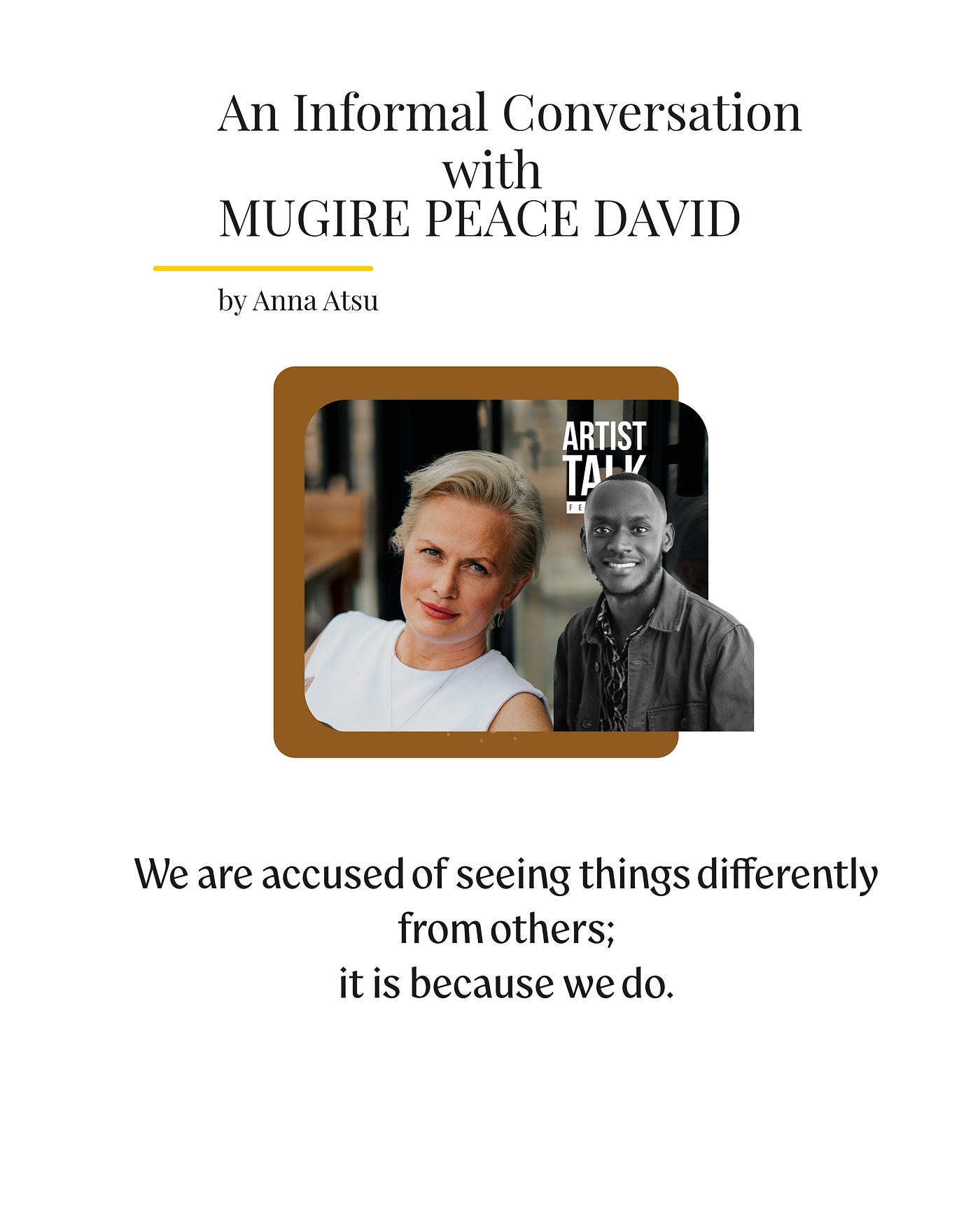
My main source of information was Komez Art. This is where you sell your pieces, don’t you? So there’s not an awful lot of information about you apart from, you know, your profile, the representation that we all know: Fine Art Painter, multidisciplinary visual artist who uses his work as an instrument to tell real-life stories and highlight the most important aspects of life to society.
Here we would like a little of your personal story, if this is what you would like to share with us.
From those platforms, you only learn a couple of lines about the artist — sorry to say, just a simple biography.
Well, obviously that’s what they do, but not what I tend to do.
OK, so please let me know — what do you want to hear from me?
I would like you to tell me things that no one knows.
OK, so secrets.
Yes, absolutely, still without pulling you by the tongue. You will tell me what you want to disclose. I was wondering first: is there anything from you as a city boy that impacted who you are today as a person, as an artist?
I think it has been. That’s where I feel really connected.
You are drinking Fanta.
Oh my God, yeah.
Yeah — famous soft drink of Rwanda.
Yeah, I just have to drink it because I don’t see it in Europe, so I have to find it here and drink it.
Yes. So I was asking about your childhood. We don’t know anything about it. We don’t know how you grew up, who you grew up with, what happened on the way, or what made you start to paint. Please, tell us about it.
OK. I was born and raised here in Kigali. I would say that I’m a city boy, as you said. I was born in 2002, from a very big family — six, children and parents. We got lucky to live with our parents all the time.
Growing up, I couldn’t see anybody in the family who was an artist, for real. But my father was an architect at that time, so I could see some sketches on paper — houses, not paintings or whatever, but sketches. So I think that really drove me to love art.
I remember the first person who told me I was talented was my nursery school teacher. Luckily, we are still in contact — we still talk, and she knows my progress. So I would say that I started drawing in nursery school, as far as I can remember.
Growing up, it wasn’t easy for me to choose art because my parents didn’t really believe in art before. Not only my parents — also uncles, aunties, everybody in the family couldn’t believe that I could pursue art and become who I am today. They wanted me to be maybe an administrator, engineer, or whatever. But it wouldn’t be just to blame them because it’s the society and the country we grew up in, the economy and everything. It wasn’t easy for parents to understand how a kid could be an artist and make a living from it.
But fortunately, I made it.
So I went to normal schools — government-sponsored schools here in Kigali. I went to primary school in a neighbourhood called Kacyiru. From 2009, the system was still in French, and then they shifted to English. I would say I was in the first promotion that started with English. It was new, even the teachers were struggling to speak fluent English, so it wasn’t easy.
That’s why I asked if it’s David or Davide.
I remember when I was in P4, primary four, I used to draw African maps, Rwanda maps, on the blackboard for the kids — graphical things. I started to be a star from that time. Everybody knew the guy who was really good at drawing maps. So I got a lot of motivation.
From that time, I started to think of continuing art in high school as well. It wasn’t easy, but I made it. In 2018, I joined an art school.
Nyundo.
Oh, you know it. Yes.
Before that, I made some money drawing pencil portraits, but I was just doing it for fun. Joining school really shaped me into a professional artist.
I started thinking: how am I going to survive with this talent? How am I going to make sure that the school fees were a return on investment?
I approached galleries, painters I knew. I was lucky to know many painters because I was born and raised in Kacyiru. It was the first neighbourhood where art really started in Rwanda around 2008–2010. Galleries were born there. I grew up knowing artists.
I remember my first exhibition — a group exhibition. I exhibited with big artists and all my pieces sold.
I was like, wow, this is it.
I started making money and proved to my parents that this could work.
I graduated in 2021 and joined many galleries in Kigali as a professional artist. I started travelling — Europe, selling works to the USA, Germany, Netherlands, Italy, France, Philippines and Qatar. I taught for a few months in Belgium in art academies. I did exhibitions there.
So my professional journey started then — building a portfolio, working with big galleries.
So may we say that Ecole D’Arts De Nyundo really opens the door to an artist?
Yes, Nyundo really opened doors. It’s not only about the school itself but also about society when you find yourself, the peers, the colleagues, you can see that you have to compete. This is when I had to open my eyes and do incredible things. So I would say at school, that school had really opened the doors for many, many different artists, not necessarily through exhibitions, but through exposure.
Who influenced you later on?
From childhood, I worked with watercolours, inks, and pens. In art school, I started oils and acrylics. After graduating, I met Akimana Fabien, a local Rwandan artist.
Fabien later opened ABIEN ARTS CENTRE.
Yes, the centre, you know that guy?
Not personally. His work is displayed at the NIYO art.
Yes, it’s him.
He told me: You can try to make all these practises, the styles into one unique style.
That’s how I came up with a mixed media style: pen, paint, ink and many different things. So I would say that that guy really. He gave me a brilliant idea and really influenced my style ’cause from that time I started to mix up everything that I know, like the things that I have been working on since childhood and to this point.
I’m also influenced by a lady from the USA called Deborah, whose work I love. Colleagues influence me too.
Style always changes. Sometimes I look at work from three years ago and don’t like it. Other times, I look at work from ten years ago and think, wow, I can’t even do that again.
I destroy my work sometimes. Even yesterday, I cut a painting into parts. I flipped works so I don’t keep adding to them.
Camille Pissarro said: “Work at the same time upon sky, water, branches, ground, keeping everything going on an equal basis and unceasingly reworking until you have brought it to the point you want.” And that point you want often doesn’t arrive.
Very true.
I would like to talk to you about your artwork, particularly pieces that struck me. There is “Wild Dreams” with a man with a peculiar look, rather traditional outfit in front of the White House…
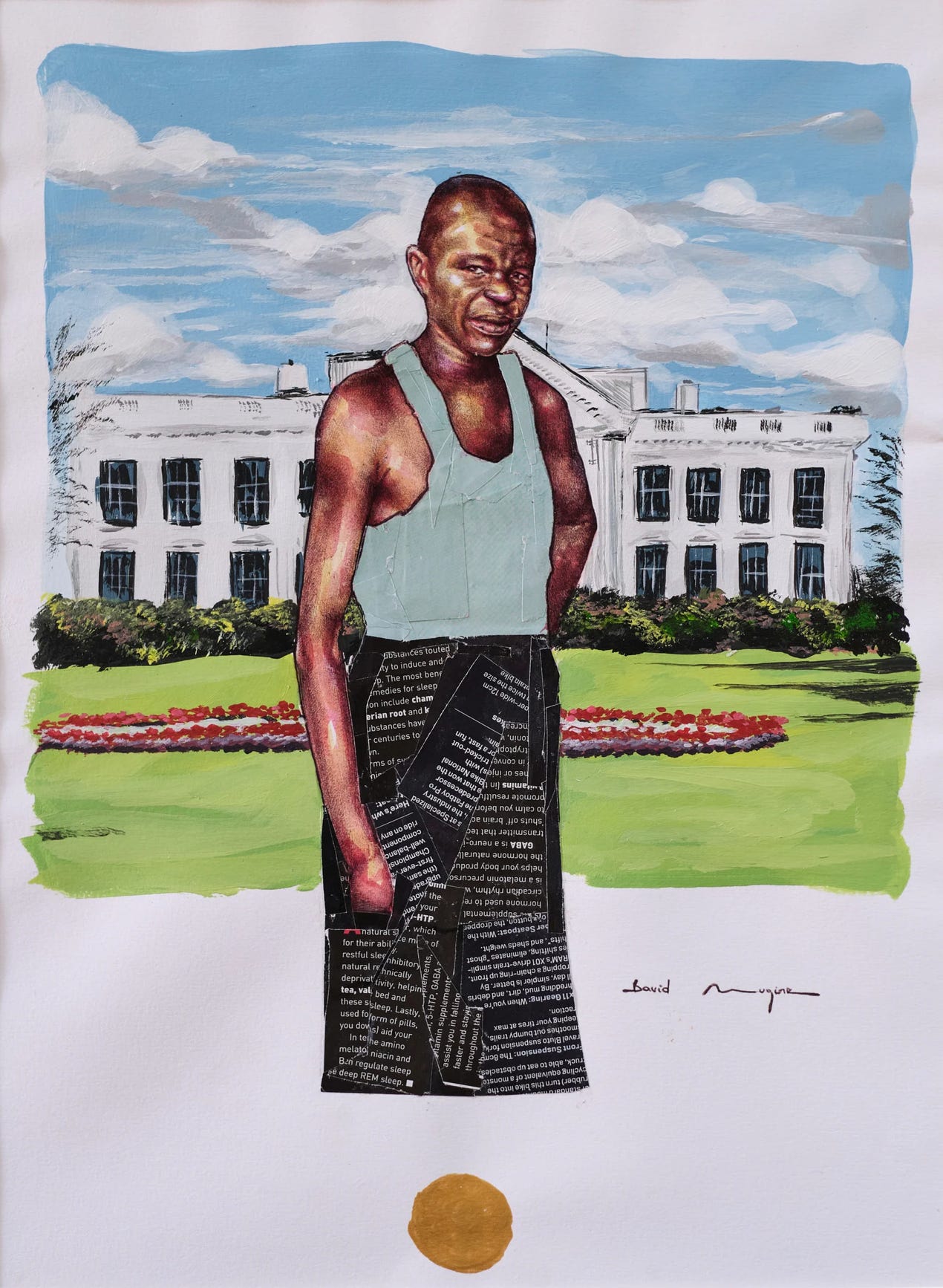
It was a farmer whom I talked to, he lived in a remote village in Rwanda, had many great ideas, and dreamed of becoming President of the USA. And here he was, where he was. I called it Wild Dreams. Dreams have no limits. I wanted him symbolic. There is a small ball at the bottom. It symbolises the brilliance. Brilliant ideas, bright future, brilliant everything.
Actually speaking a little bit about my process, I get an idea, and I go into my sketchbook. I try to combine everything, every idea that I have. Even in this case, started like that.
And the text on kitenge?
The texts on clothing come from books and old magazines. Don’t you worry, I don’t destroy people’s books. I select words that fit the idea. Recently, I also used AI-generated text, printed and cut.
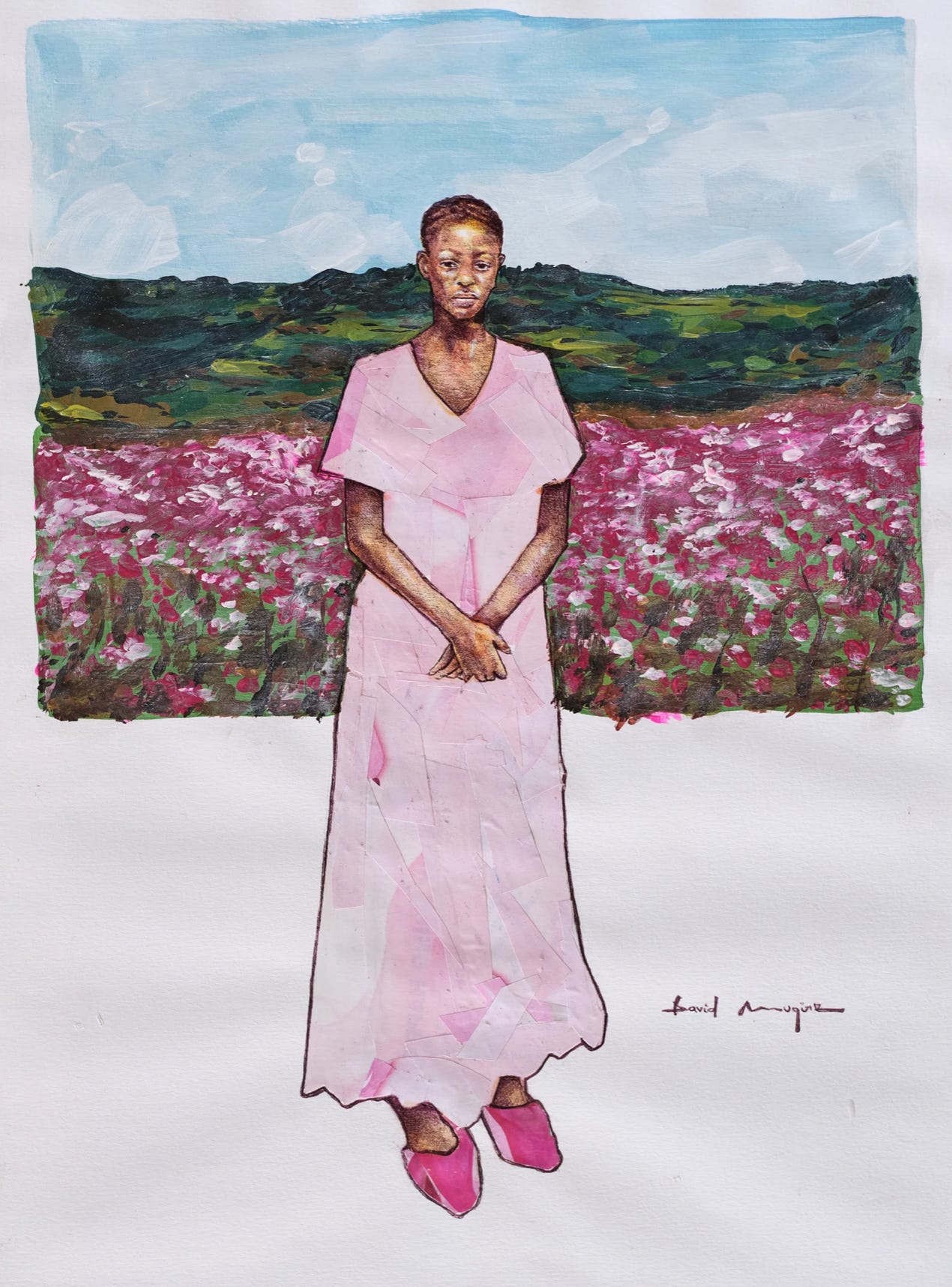
I must ask about the women figures in your painting, that incredible painting, entitled “Queen”. Pink background, flowers and in the middle, a woman in a pink dress with disproportionately big slippers or shoes? Tell me. Tell me more about it.
People have been asking me why I love painting male figures. Why are you into it a lot? And there was like, you know, let me try to challenge myself to work with the female figures, to hear their stories. And I think currently, I’m loving them a lot. So in that particular work, many different women love pink, so I went to explain the feminine energy, trying to romanticise it with a very good dress, the flowers and everything, yeah. I do believe that every woman should feel like a queen.
Absolutely.
Children appear a lot, too.
I had a friend in Belgium. She’s a very good lady and a good friend of mine. She has PhD in psychology. So she asked, ‘David, tell me more about your story, about what you’ve been through, about everything’. So we, we had a conversation, a very good conversation. And after a while, she was like, ‘I asked you that question so that I can try to reflect on the work that you do.’ Cause, you know, sometimes artists cannot really explain what they’re doing, it just comes naturally, an expression of the things. So when you hear about what they have been through, you can be like, oh, OK, now I get it. So I think that’s my, my, my perspective on love. Bring the kids a lot. Yeah. It’s just my life, what I have been through as a kid.
Do you think you have ever portrayed yourself?
No, no, no, no, no. The self-portrait. Yeah, as a key to adulthood. Maybe, maybe, maybe I don’t have good pictures of myself.
These paintings of children are incredible. I love them.
Thank you. And I have a new collection of the works that I will be posting in the coming days.
I can see so many already, for example, that girl in “Glipse of Legacy 04”, she has that incredible, piercing look. And then you have the pieces of material as clothing, the background is painted. Tell me more.
Well. I would say that I mixed up many different things, as I told you. Growing up working with watercolours, I use them mostly in the dresses and the hands and legs and everything. Paper cutting, you know, oil paints just as a background, a landscape in the back, I use acrylics and oil paints, and sometimes even use pastels. I use watercolours. I mean, I use many different things.
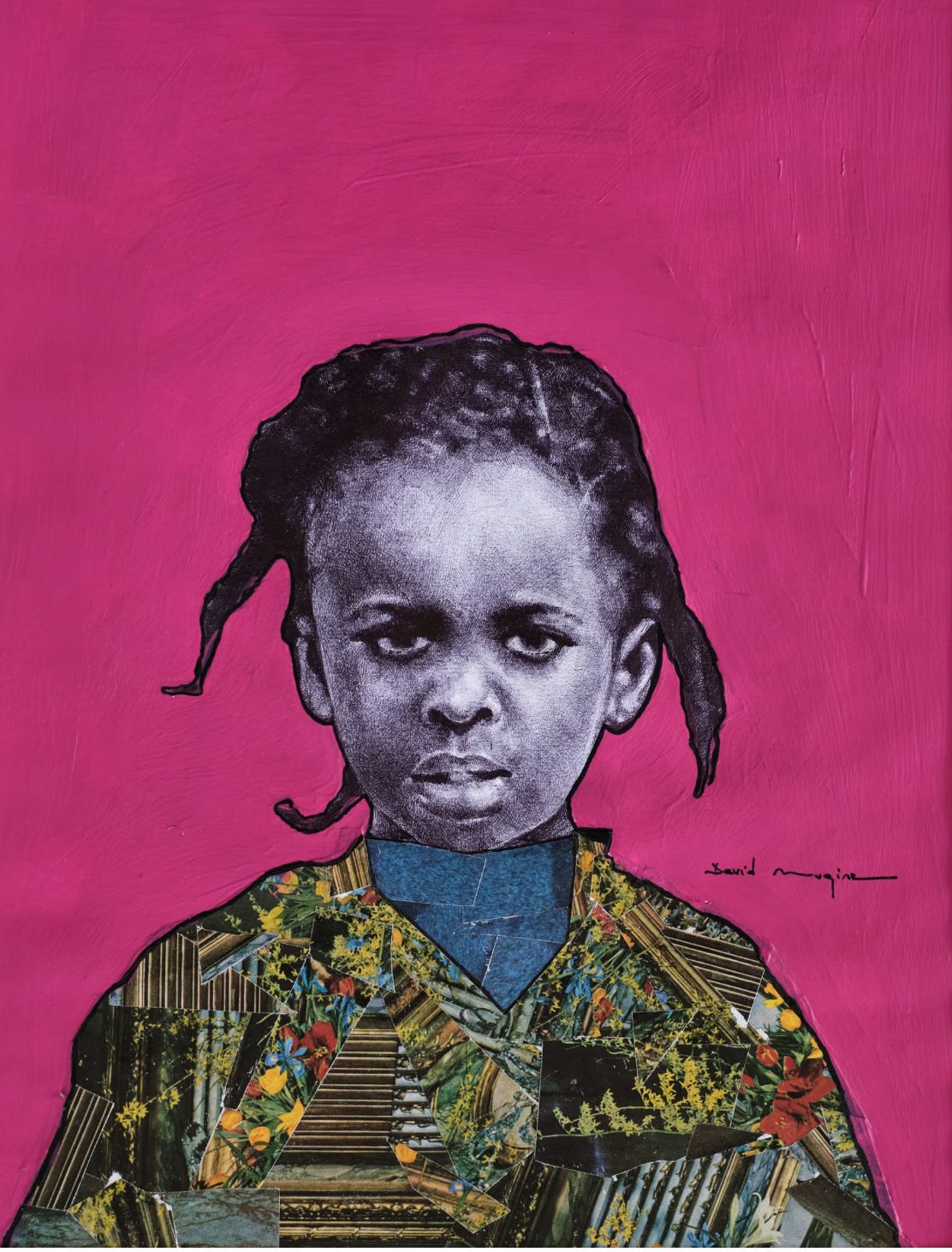
It’s like problem-solving or challenging myself. Why can’t I use this? Why can’t I try to put on some clothes on the things? But for me as a person, I believe that the best artists are the artists who are not limited to any sort of materials, are the artists who can do art without needing many things.